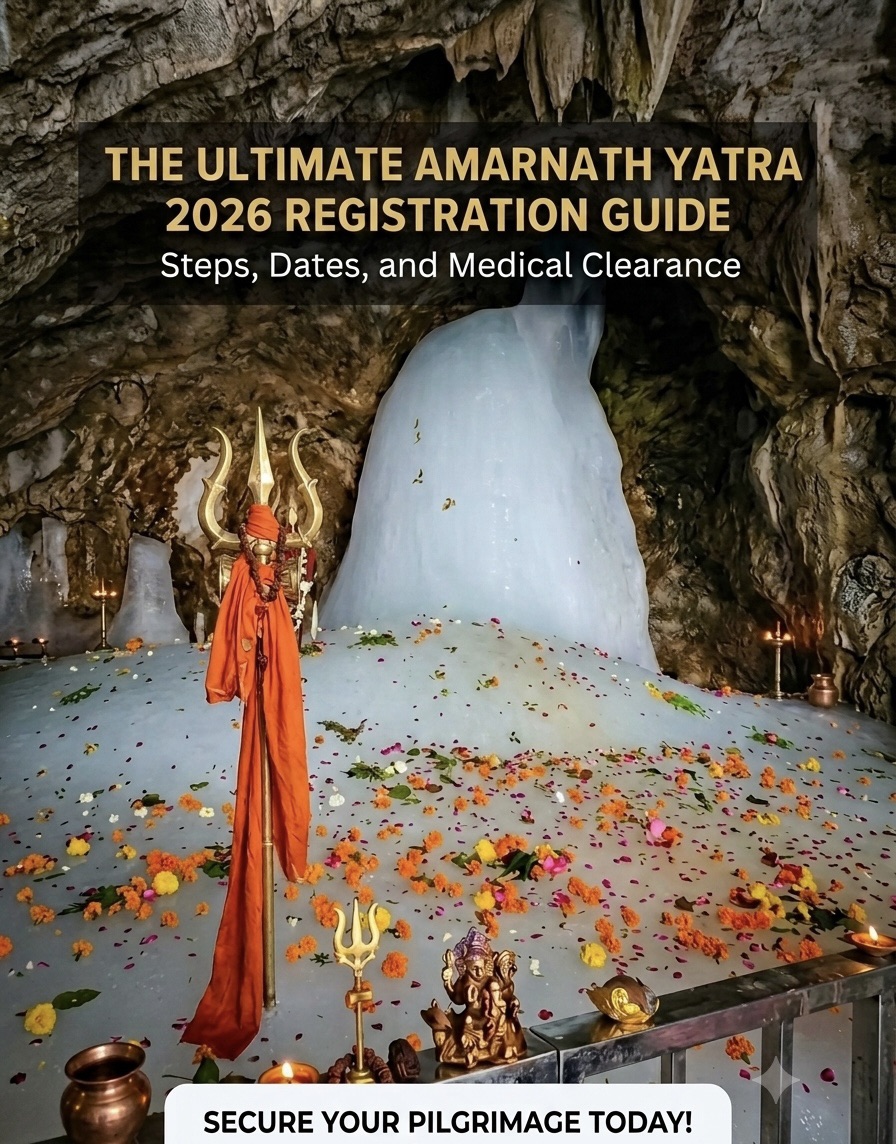
Planning the Amarnath Yatra in 2026 is a deeply spiritual journey, but it requires strict logistical preparation. Because the holy cave sits at a punishing altitude of 3,888 meters (12,756 feet) in the rugged Himalayas of Jammu & Kashmir, the Government of India and the Shri Amarnathji Shrine Board (SASB) regulate access heavily.

The 2026 Amarnath Yatra officially starts on July 3, 2026, and concludes on August 28, 2026, spanning a total of 57 days. Advance registrations opened on April 15, 2026.
You cannot simply show up and hike. You need prior authorization. This comprehensive 2026 guide breaks down every step required to secure your permits, pass your medical exams, and successfully reach the starting point of your pilgrimage.
1. Understand the Mandatory 2026 Requirements
Before spending money on gear or booking travel to Srinagar, ensure you meet the basic eligibility criteria set by the SASB:
- Age Limits: Pilgrims must be between 13 and 70 years old. Anyone under 13 or over 70 will be denied entry.
- Pregnancy Restrictions: Women who are more than 6 weeks pregnant are strictly prohibited from undertaking the trek.
- Key Documents: Prepare your Aadhaar Card (or passport for NRIs), government photo ID, and 4 recent passport-sized photographs.
2. Obtain Your Compulsory Health Certificate (CHC)
The single most critical document you need is the Compulsory Health Certificate (CHC). High altitude presents extreme risks of Acute Mountain Sickness (AMS), making medical clearing non-negotiable.
- Issue Window: For the 2026 season, your CHC must have been issued on or after April 8, 2026. Old certificates are completely invalid.
- Authorized Doctors Only: You cannot get this certificate from just any local clinic. The SASB Official Portal publishes a designated state-wise list of authorized doctors and government hospitals.
- The Medical Exam: The doctor will check your blood pressure, cardiovascular health, and lung capacity to ensure you can handle steep, low-oxygen climbs. Your photograph must be physically attached and attested by the doctor on the form.
3. Secure Your Advance Yatra Permit (Registration)
Once you have your stamped 2026 CHC, you can secure your official Yatra Permit for a fee of ₹150 per pilgrim.
Option A: Online Registration (Highly Recommended)
- Go directly to the official Shri Amarnathji Shrine Board Portal.
- Fill out the application form with your personal details, choice of route, and travel dates.
- Upload scanned copies of your photo ID, passport photo, and your CHC.
- Pay the ₹150 registration fee online.
- Download and print your digital, color-coded Yatra Permit.
Option B: Offline Registration via Banks
If you prefer an in-person process, advance registration is active at over 540 designated branches across India:
- Participating Banks: Punjab National Bank (PNB), State Bank of India (SBI), Jammu & Kashmir Bank (J&K Bank), and YES Bank.
- Process: Walk into a designated branch with your physical CHC, original IDs, photos, and the registration fee. The bank will issue a system-generated physical permit.
4. Choose Your Trekking Route
When registering, you must lock in your route. Daily quotas are strictly enforced at a cap of 10,000 to 15,000 pilgrims per day per route to avoid overcrowding and ensure safety.FeatureBaltal RoutePahalgam RouteStarting PointSonamarg / BaltalAnantnag / PahalgamTotal Distance14 Kilometers46-48 KilometersTime Required1 – 2 Days4 – 5 DaysTerrain TypeVery steep, narrowGradual, wide, scenicBest ForFit, fast trekkersTraditional pilgrims
(Note: Limited helicopter options exist to Panchtarni, but the final 6 kilometers to the cave shrine must still be covered on foot, by pony, or by palanquin).
5. Collect Your Mandatory RFID Tag
Even with a printed permit and medical certificate, you are barred from passing the final access control checkpoints without an RFID (Radio Frequency Identification) Tag. The government utilizes these tags to track real-time coordinates for emergency mountain rescue operations.
- Where to Collect: Active RFID counters are set up at Jammu Railway Station, Jammu Airport, Katra, and the main base camps in Baltal and Nunwan (Pahalgam).
- Cost: The tag is issued completely free of charge.
- Strict Rule: The tag must be worn around your neck at all times during the entire duration of the trek.
Final 2026 Pro-Tips for Travel Bloggers & Pilgrims
- On-Spot Registration: For last-minute travelers arriving in July, on-spot current registration facility is active at designated places in Jammu (like the Tawi Riverfront counters, Vaishnavi Dham, and Saraswati Dham).
- Physical Conditioning: SASB strongly advises starting a daily physical regimen of walking 4-5 km per day and practicing deep breathing exercises (Pranayam) at least a month prior to the trek to build oxygen efficiency.
- Connectivity: Keep a postpaid BSNL, Airtel, or Jio SIM card handy. Prepaid connections from outside Jammu & Kashmir do not work in the valley due to security protocols.